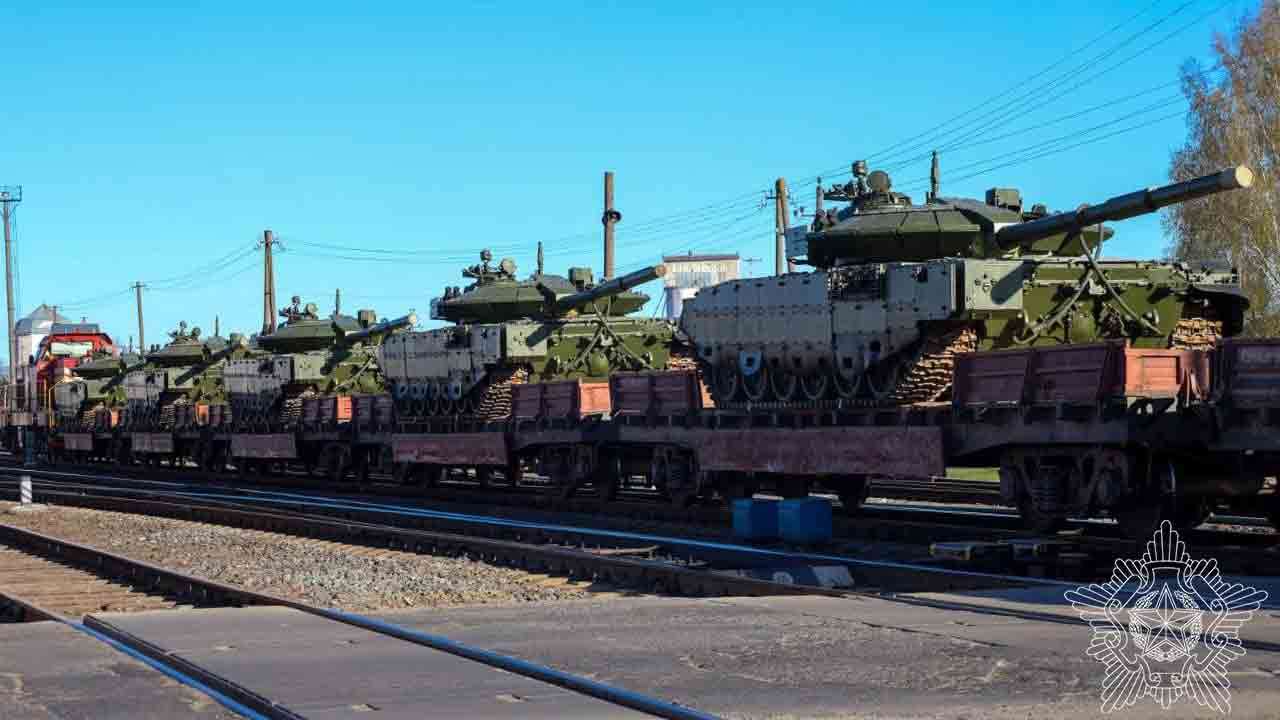
The first serial batch of Belarus’s locally modernized T-72B was delivered to a brigade based in Slonim, a strategic area near the borders with Poland, Lithuania and Ukraine.
Belarus has begun serial deliveries of the T-72BM2, a locally upgraded version of the T-72B, in a move that strengthens one of the mechanized brigades stationed in the western part of the country, near NATO’s eastern flank.
According to the Ministry of Defense of Belarus, the tank battalion of the 11th Separate Guards Mechanized Brigade received the first serial batch of the new armored vehicles. The exact number was not officially disclosed, but images released by the ministry show the transport of five tanks.
“Today we received combat vehicles that meet all the requirements of modern combined arms warfare. I want to emphasize that this is only the first stage in acquiring the most modern combat vehicles. In the near future, this practice will continue, and we will receive new weapons, military and special equipment to carry out assigned tasks as intended,” said the brigade commander, Guards Colonel Vadym Ilnytskyi.
Brigade is located around 100 km from the Polish border
The delivery draws attention not only because of the equipment itself, but also because of the location of the unit that received the armored vehicles.
The 11th Separate Guards Mechanized Brigade is part of Belarus’s Western Operational Command and is based in the city of Slonim.
From the brigade’s deployment area, it is about 100 kilometers to the border with Poland, just over 110 kilometers to Lithuania, and approximately 125 kilometers to Ukraine.
In practice, the T-72BM2s are now reinforcing a formation positioned in one of Belarus’s most sensitive regions, close both to NATO countries and to Ukraine’s northern border.
What changes with the T-72BM2
The T-72BM2 was first unveiled in July 2022 as a Belarusian modernization of the T-72B. Since then, a small number of vehicles had been undergoing troop trials before the delivery of the first serial batch.
The project was developed by engineers and designers from the 140th Armored Repair Plant, located in Borisov, near Minsk.
During the upgrade to the T-72BM2 standard, the tanks receive an improved fire-control system, including a new multichannel sight with optical and thermal channels, a missile guidance channel and a laser rangefinder.
Sensors aimed at improving firing accuracy have also been updated, including a meteorological sensor, wind, roll and pitch sensors, as well as charge temperature sensors.
The tank also receives a new ballistic computer, responsible for providing automatic corrections to the sight during firing. Another new feature is the “Double” mode, which allows weapon control and firing from the tank commander’s position.
Vehicle gets new sensors, but images show no anti-drone protection
The T-72BM2 has also been equipped with modern optical and thermal imaging devices for the commander and the driver.
Another improvement is the installation of an auxiliary diesel-electric generator, which allows the tank’s main systems to operate without turning on the main engine. This feature can reduce fuel consumption and help during stationary operations.
For protection, the tank received a new reactive armor package developed in Belarus. The system visually resembles the Russian Relikt, but is presented as a local solution.
Even so, the images released by the Belarusian Ministry of Defense do not show additional anti-drone protection systems such as slat screens, electronic warfare equipment or active protection systems. This absence stands out because, in 2022, T-72BM2 vehicles were shown with early versions of overhead structures commonly described as “cages” or “barbecues.”
Analysts point to possible weak spots in protection
Although Belarus says the modernization took into account the experience of modern conflicts, analysts point to limitations in the layout of the T-72BM2’s reactive armor.
Among the areas cited are potentially weakened sections on the upper front hull, the turret ring area and the upper frontal section of the turret itself.
These details matter because modern warfare has highlighted the growing importance of protection against top-attack munitions, FPV drones, guided munitions and anti-tank threats launched from multiple angles.
Upgrade suggests an effort to extend the service life of the T-72 fleet
The arrival of the first serial batch suggests that the T-72BM2 has moved beyond the testing phase and entered a new stage of service introduction.
For Belarus, the modernization represents a way to extend the service life of its T-72B fleet by adding new sensors, sighting systems, a ballistic computer, thermal capability and updated reactive protection without the need to acquire an entirely new tank.
The Belarusian Ministry of Defense indicated that new deliveries are expected soon. However, the total number of vehicles to be modernized has not yet been disclosed.
Source and images: Ministry of Defense of Belarus