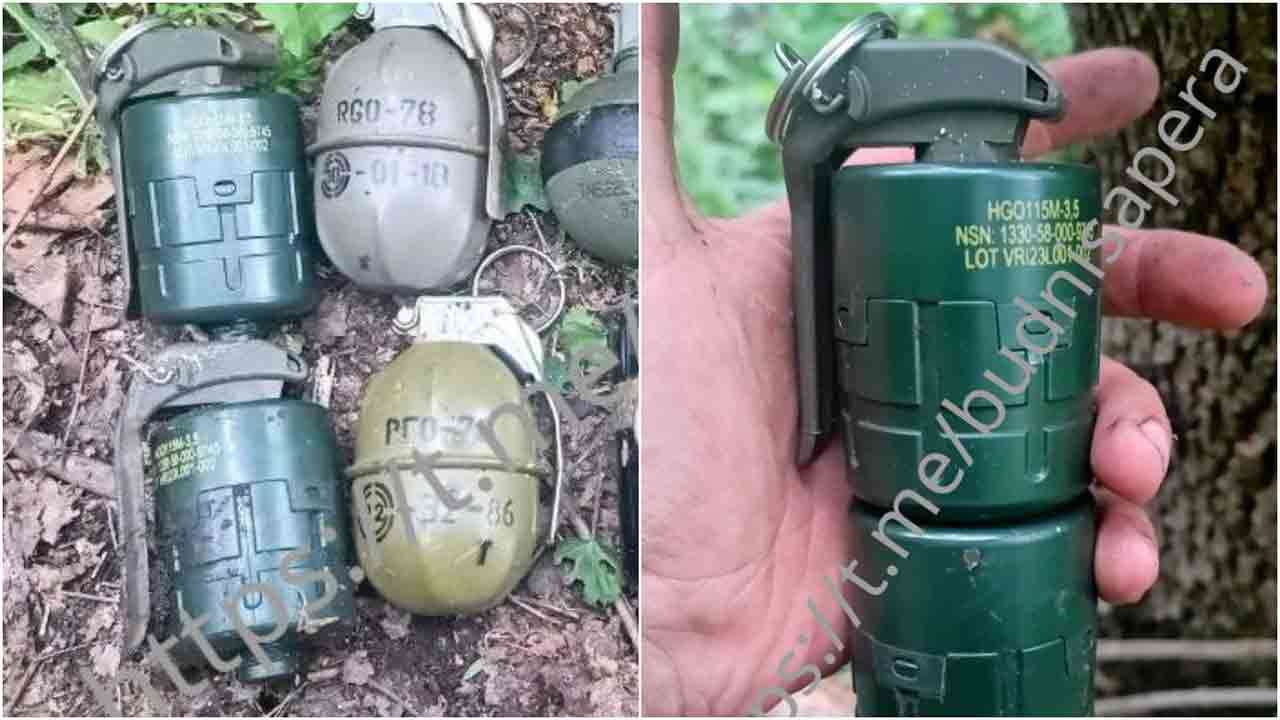
The weapon drew attention after several units reportedly fell into the hands of Russian forces, which published images of the material on the Budni Sapera channel on Telegram.
The SOHG system stands out for its modular concept, allowing the explosive yield to be adjusted according to operational needs. Nammo’s proposal is to offer a scalable offensive grenade that can be used individually or combined with other modules to form a longer and more powerful charge.
According to the information released, several of these modules can be connected together into a single grenade. Although the design technically allows more units to be assembled, the manufacturer recommends combining no more than three modules, increasing tactical flexibility in different combat scenarios.
Nammo uses different types of explosives to fill the SOHG grenades. In one configuration, the charge contains 115 grams of TNT. In another, the explosive can be Composition B or PBXN-110, both hexogen-based, raising the charge to 130 grams.
Each SOHG module is about 90 mm tall, 53 mm in diameter, and has a total weight of 140 grams. The system uses a standard fuze compatible with all grenades developed by Nammo, simplifying field use.
Activation is carried out through a traditional pull ring, and the time between striker activation and grenade detonation is approximately 3.5 seconds. The flame is transmitted internally through channels inside the casings, allowing a single fuze to activate several connected explosive charges.
Before the arrival of the SOHG grenades, the Ukrainian army had already received Finnish-made m/50 fragmentation grenades. The incorporation of the new Norwegian system expands the range of munitions available to Ukrainian forces, especially in operations that require greater adaptation of explosive yield.
Source and images: Telegram @budnisapera